Week 10: Internet of Things
Assignment Connect your microcontroller board with other device: it can be another microcontroller, application in cloud, a mobile phone… They should be able to communicate data generated/sensed using the board to the other end (E.g. of use case: monitoring system for school). You can also use your board to receive instructions from the other device (use case: robotics).
As an extra work, each device might belong to other FLA student from other lab / your own lab.
In your documentation, name the devices you’re using, along with the platform or technology used for communication between them. Clearly explain what you’re measuring and describe how data is communicated between the two endpoints. If you’re using external components, include a simple diagram illustrating how they’re connected. Provide your code (or a link to your code) for both ends, and include screenshots of the online system’s configuration, if applicable. Add several pictures showcasing your project. If possible, include a video demonstration.
Process As I was planning this week’s assignment, I discussed potential ideas to support our local gardening/micro-herbs club. One key challenge the club faces is that all plants are treated the same in terms of soil moisture, temperature, and light exposure, since they are kept in the same room. As a result, some plants thrive while others struggle. This led me to the idea of designing a sensor system that could monitor soil moisture, light levels, and temperature for more informed plant care.
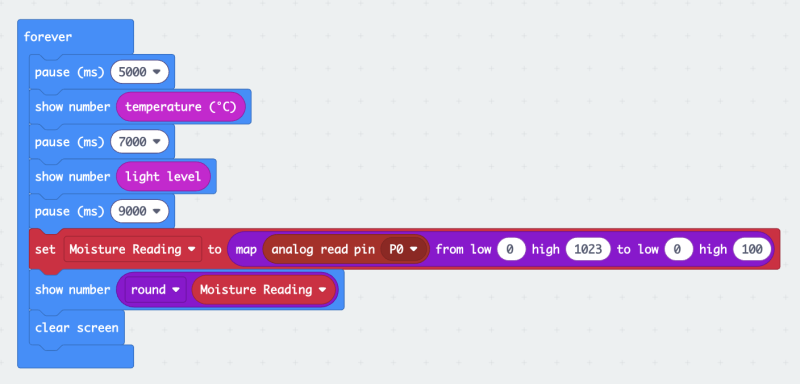
Using the Micro:bit, my colleague Brady Snyder and I set out to develop a data collection system that could help improve each plant’s growing conditions. We also wanted the system to collect data asynchronously, allowing information to be stored over time and transferred in batches rather than requiring constant real-time monitoring.
After experimenting with different versions of the code, we settled on a final design that records one reading for each of the three data points every hour.
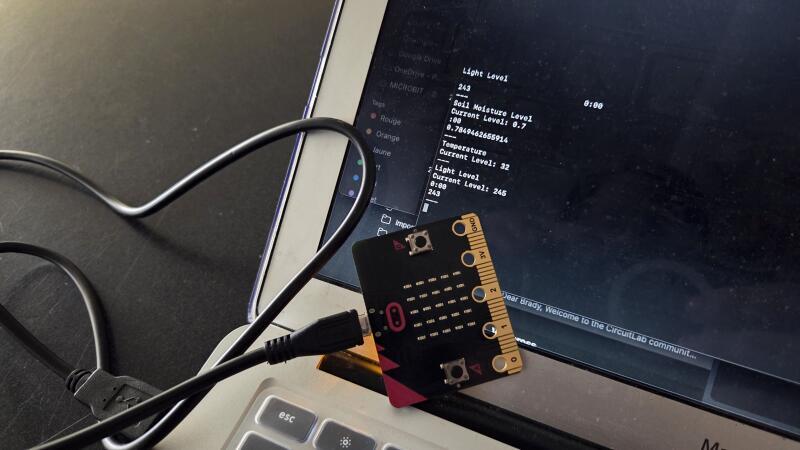
The system operates as a “set-and-forget” device, storing readings in the Micro:bit’s memory. When buttons A, B, or A+B are pressed, the device transmits the stored light level, soil moisture, and ambient temperature data respectively to a receiving Micro:bit, which then displays the collected hourly information. This approach allows data to be retrieved at any time after setup without needing the receiver to remain continuously connected.


Reflection
What are some opportunities in your context to work within your local community? Who you could collaborate with? How? What should happen to succeed in the collaboration
There are strong opportunities within my context to collaborate both inside and outside my school community. Within my own school, I can work more closely with colleagues across different subject areas to co-develop interdisciplinary projects. For example, design, science, social studies, and language teachers could work together to create meaningful, real-world learning experiences that integrate making, problem-solving, and communication.
Beyond my school, there is also potential to collaborate with local businesses and community organizations. These partnerships could allow students to engage with authentic challenges while also using the makerspace in a mutually beneficial way. For instance, local organizations could present design problems or sustainability challenges that students could work on in the makerspace, giving students real-world relevance to their learning.
Additionally, many schools across the Montreal area are beginning to invest in makerspaces, fablabs, woodworking shops, and 3D printing technologies. There is a valuable opportunity to build a regional network where educators can meet, share resources, exchange ideas, and showcase student work. Success in this type of collaboration would involve consistent knowledge-sharing, joint projects, and the development of a stronger makerspace culture across Montreal schools. Ultimately, this would help strengthen innovation and creativity in education across the region.
What are the next steps in development further a makerspace in your school? How do you envision the maker space?
One of the key next steps is increasing dedicated class time for design and making-based learning. In order for the makerspace to reach its full potential, students need regular, structured opportunities to engage in hands-on design work.
It is also important for both school leadership and teachers across disciplines to recognize that the skills developed in the makerspace are highly transferable. Students are not only learning technical skills, but also essential competencies such as collaboration, iteration, critical thinking, and project management. Emphasizing these outcomes will help strengthen the role of the makerspace within the broader curriculum and ensure it is seen as an essential learning environment rather than an optional space.
In the future, I also envision expanding the integration of project-based learning across subjects, where the makerspace becomes a central hub for applied learning experiences.
What is the potential of physical computing and IoT for your teaching? Do you have any ideas on how you are planning to integrate those techniques in your context?
Physical computing and the Internet of Things (IoT) have strong potential to enhance my teaching practice by making learning more interactive, data-driven, and connected to real-world contexts. Using tools such as the Micro:bit, students can design systems that sense, respond to, and collect data from their environment.
For example, I am already exploring projects involving environmental monitoring systems, such as sensors that measure temperature, light levels, and soil moisture. These types of projects can be directly integrated into my curriculum, including the Field Activity 4 project, where students could design and deploy simple data collection devices to solve real problems.
Going forward, I plan to incorporate more IoT-based learning experiences where students not only build physical prototypes but also analyze and interpret the data they collect. This could include smart plant systems, classroom environmental monitoring, or even community-based data collection projects. These approaches help students see the real-world impact of technology while developing both technical and analytical skills.