M3 Field Activity
Scopes Lesson
Reflection
To collect feedback, I utilized a combination of direct observation during the classroom session and an iterative dialogue with Gemini (AI) to audit my lesson’s alignment with National Core Arts Standards (NCAS) and SDG 12. The specific feedback highlighted that defining “Digital Fabrication” through bio-extraction successfully bridges the gap between traditional art and modern process engineering, provided the “Technical Calibration” (the tonal scale) was assessed as a measurable skill. The assessment protocol aligns with the learning goals by shifting the focus from purely aesthetic outcomes to material literacy, ensuring the 4-step gradient acted as evidence of technical mastery. The pacing—separating the “Engineering” (extraction) from the “Expression” (Amaya-inspired painting)—made the lesson accessible within the students’ Zone of Proximal Development (ZPD).
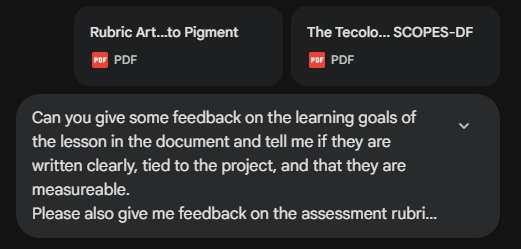
I used “Gemini” to get feedback from the lesson. This is the prompt I used to ask feedback from AI using as a reference the document in Scopes and the rubric created for the project.
This is the feedback obtained from the prompt and documents uploaded.
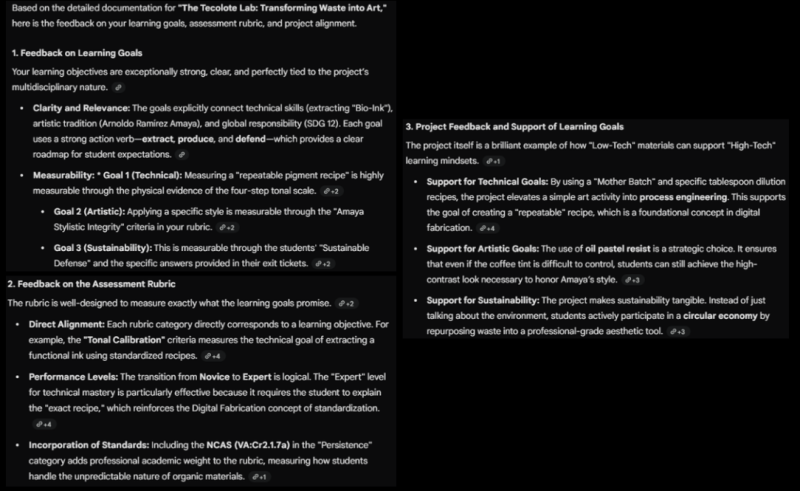
Based on that feedback I’ll answer the following questions:
What was the specific feedback about how the project aligns with learning goals? How does the assessment align with the learning goals? Does the assessment protocol make sense within the lesson (ie. type of assessment, pacing, difficulty of implementing) Gemini tells that the learning goals are measurable through the evaluation provided (the reading questions, the rubric and final students’ reflection), on the specific learning goals for sustainability, and artistic standards.
What are some changes you made or will make based on the lesson testing and feedback? I liked the idea of providing a reading for students to learn more about the sustainability of the lesson, with more time we could also work on reasearching other techniques where natural tints can be obtained through extraction process or even flower printing and the benefits of using natural resources that don’t generate waste or could be useful for the nature cycle process. I would probably try other ways of creating tints and then make a different project based on a different artist and adding more natural tints.
Did you succeed integrating developed sustainable goals / sustainability? Are they included in the learning goals and assessment? There were any challenges related to the integration? According to Gemini the integration of sustainable goals is succesful due to the reading and analisis of the “Art with a Conscience: From Plastic to Pigment” reading, I think we could also challenge ourselves next time by using different techniques to obtain different natural tints. I also made some reasearch and learned that there’s also the posibility of creating watercolor tints from scratch using different vegetables and create a palete of tints, so I think this would be challenging to try with students but at the same time we could have a discussion of why it matters and how it helps the ecosystem to avoid using paint that generates mycroplatic waste.
Tools
-Dark Roast Coffee Grounds -Spoon -Plastic or glass cups -Electric Kettle -Fine Mesh Strainer or Coffee Filters -High-Absorbency Watercolor Paper (300gsm) -Oil Pastels -Assorted Brushes -Mixing Palettes -Recycled Rags or Paper Towels