M4 Week 1
Assignments
- Use one development board (arduino, microbit …) and use it to sense something in your class (noise / light / movement) and produce some kind of response (audio, light, movement)
Process
-For this project, I created a classroom sound level monitor using a Micro:bit development board. The purpose of this tool is to help manage classroom noise levels in an interactive and visual way. The Micro:bit senses ambient sound and provides immediate feedback to students through icons displayed on its LED screen.
This project is designed not only as a technical exercise but also as a behavior management strategy that encourages student self-regulation.
While the specific model that I’m using does not measure in decibels (dB), according to some research made by myself The Micro:bit measures sound levels using its built-in microphone. It provides a relative sound value from 0 to 255 (where 0 is very quiet and 255 is very loud), rather than measuring in decibels (dB). The idea of this project is showing students that: * Low to medium sound levels: Indicate acceptable classroom noise * High sound levels: Indicate excessive noise
-First I created and worked on the code in the website https://makecode.microbit.org/#editor -While creating the code I decided how the actuator is going to be used; based on the detected sound level: * A happy face is displayed when the classroom noise is within an acceptable range. * A scared face is displayed when the noise level exceeds a defined threshold.
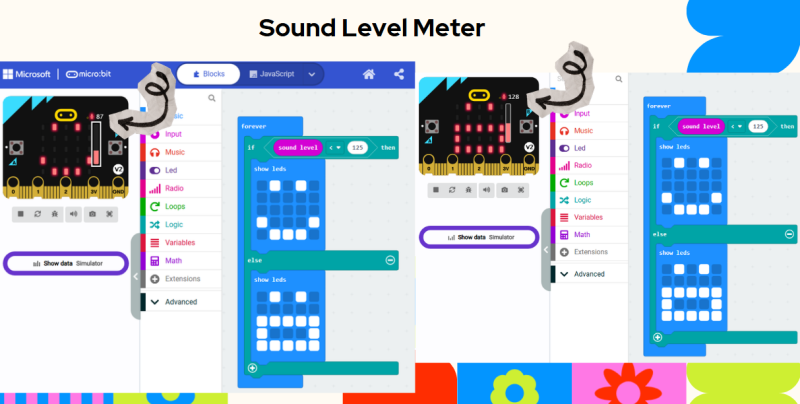
This immediate visual feedback helps students become aware of their noise levels and adjust their behavior accordingly.
I plan to use this device as part of a classroom management system: As a testing example, during the lesson, I will check the Micro:bit at five random times. If the device shows a happy face at least three times, the class earns a reward (e.g., free seating in the next class).
The idea is for this approach to gamify behavior expectations and promote collective responsibility.
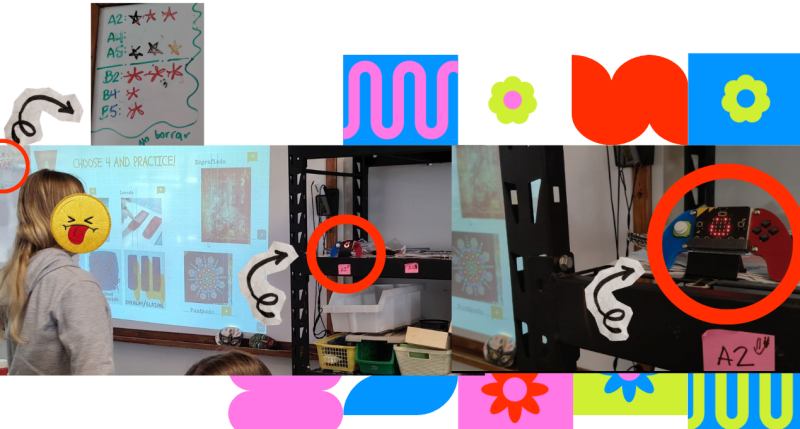
UPDATE I used the device to try it out with my students, they were very interested and helped me try it by being very silent and then shouting at my signal to see if it really worked, they had fun trying it and next class they were asking about it, unfortunately I forgot to bring it next class, but this proved that students were engaged and following expectations, it was fun and I’m working on an idea adapting these to make expectation competitions among different sections. For the first try out section A2 and section B2 earned a free seating day.
Reflection
- Did you bring several disciplines together in your own teaching? Do you collaborate with teachers in other disciplines? What are the opportunities and challenges.
I think this project brings together multiple disciplines: for technology & engineering: programming the code for Micro:bit; for science: Understanding sound and measurement (even though this can be tricky since we’re not working with decibels); for social-emotional learning: students can get self-regulation and behavior awareness; and finally for the specific subject I teach, which is art: it helps creating a positive and engaging environment which is always helpful to reach the learning goals.
As for the opportunities, I see strong potential for collaboration with science teachers because of sound measurement and it can also be helpful with data analysis and especially with music teachers to help students learn about volume control and dynamics in songs, I think this could be a very interesting tool to use for showing that and maybe analyzing music too.
For challenges, based on the specific school I’m working with, I would think a challenging thing is the access to the tools and the time to learn helpful coding. Also a challenge in general is the way the tool measures sound, I think having a standardized measure like decibels would be more helpful and easier to analyze.
- How do you envision a makerspace in your school? How does it look like? If you have one already, how would you modify it.
I envision a makerspace in my school as a flexible, creative, and student-centered environment that includes: Workstations with digital tools (Micro:bits, laser cutter, 3D printer, etc.), craft and art materials, space for collaboration and experimentation
Because of my experience as an art teacher I think it would look like a blend between an art studio and a tech lab, where students can prototype, test, and share original ideas. I’m currently working on creating an elective course for 8th graders called Design Masters Studio (Impact Studio) which will be focused on product creation based on the necessities of the school and also bringing technology at the service of others, crossing fingers for it to work and for students to get excited about it.
- After the definition of computational thinking? Are you somehow using computational thinking in your teaching? How? Do you think you can take advantage of computational thinking? How?
I think this specific project applies computational thinking by breaking down the problem of classroom noise into measurable steps. The Micro:bit collects input (sound level), processes it using a simple algorithm, and produces an output (a happy or scared face on the screen). But I also think I could use more computational thinking in my teaching by having students design their own rules and responses, helping them develop problem-solving and logical thinking skills and also using it on different projects.
Tools
- Micro:bit
- Computer