M3 Week 1
Answers to Maxime feedback…
I’m still working through the modifications for the original tractor design. Since it’s a complex file, I’ve decided to consult with an expert to help me figure out the best way to separate the components.
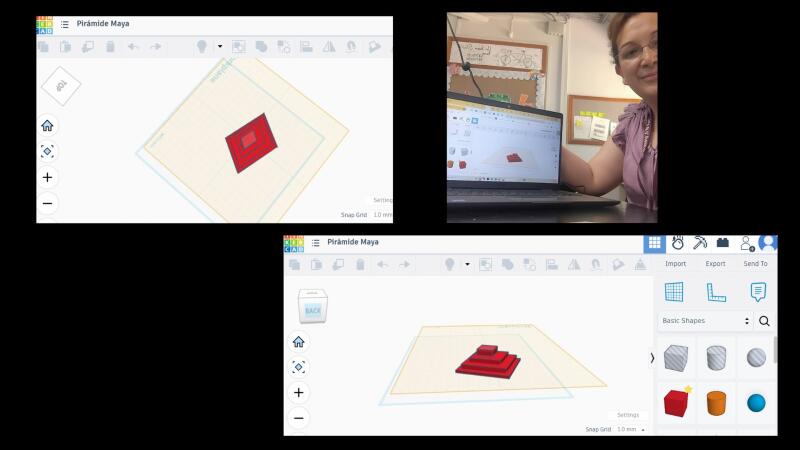
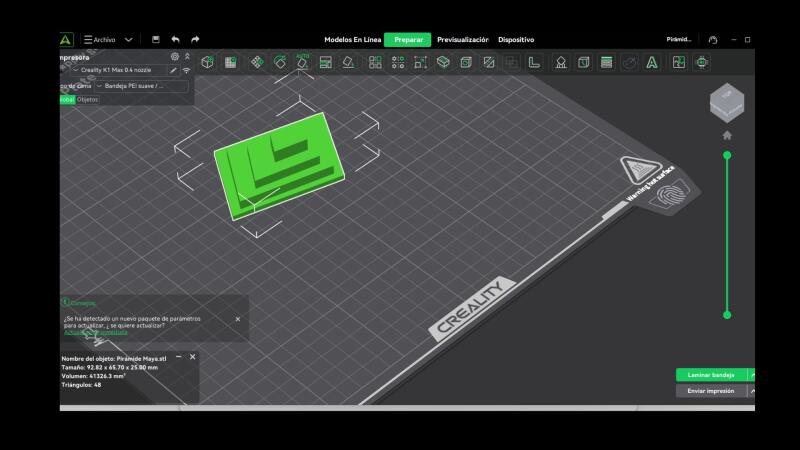
Good news… In the meantime, I’ve been busy exploring the new 3D printers in my room! I’ve successfully designed a Mayan Pyramid from scratch in Tinkercad. I’m becoming much more comfortable with the design process, specifically by experimenting with solid shapes and ‘hole’ layers to create complex geometry.
Bad news… I have some photos and the print-ready file to share, but I’ve run into a bit of a snag with the hardware. Due to the shifting temperature in the room, I’m facing filament adhesion issues. The printers worked perfectly for a few days, but now I can only get the first layer to stick before it fails. I’m currently collaborating with the technical team and all involved parties to stabilize the environment and get the machines back in good condition.
Assignments
This week you would need to fabricate a 3D object with a 3D printer. The 3D object should provide some support for your class or some of your teaching lessons. E.g. a box to store materials, a tool to help with a specific activity, a model to explain a concept, etc.
Design it from scratch or modify an existing 3D object.
3D print the object. You should do the slicing and set up the printer on your own with the support of your instructor. For advanced users: If you already are familiar with the 3D printer try to build an object that is composed by at least 2 different parts. In this case you should consider different ways of creating connecting joints and interlocking parts (opens new window)such as interlocking joints (opens new window), snap fit joints (opens new window)(including ball joints (opens new window)) or hinges (opens new window). Instead, you can also try to have articulated objects printed as one piece (opens new window), for instance an articulated snake as a pencil holder
Process
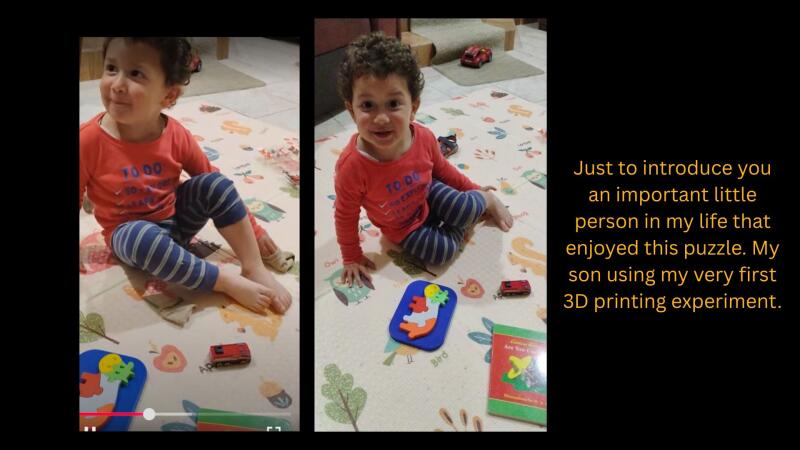
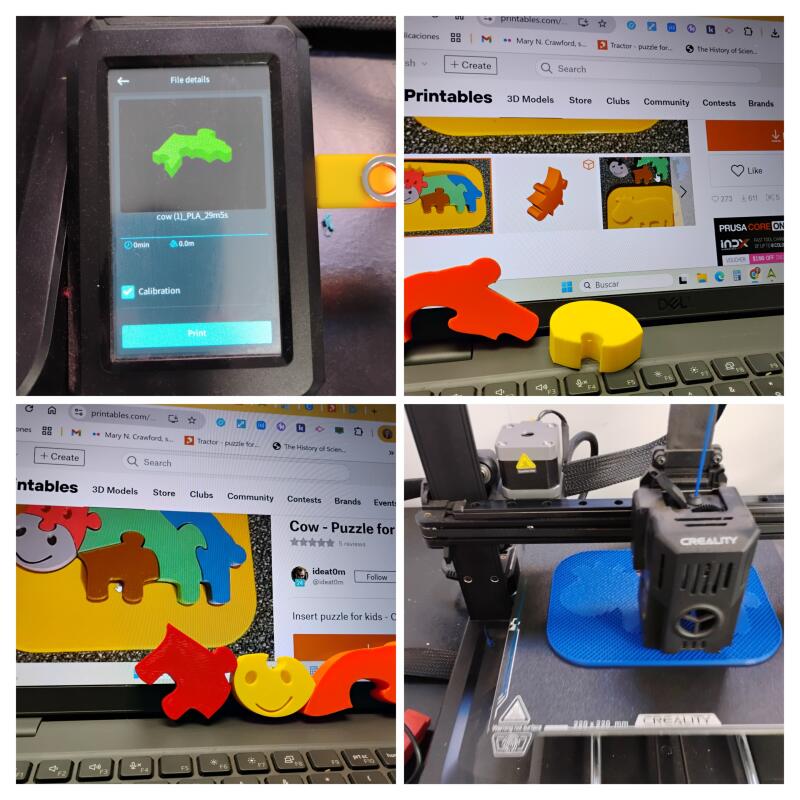
For this project, I really wanted to dive into 3D printing. I headed over to Printables and picked out two puzzle models. My first choice was a tractor, but I hit a snag: when I imported the STL, the model was one solid block instead of separate, colorful pieces. I tried taking it into Tinkercad to break it apart and color-code the components, but while I could duplicate the model, I couldn’t quite ‘ungroup’ the geometry the way I wanted. Since 3D printing takes a lot of time and I was on a deadline, I pivoted to my second model—a cow. Bingo! That one already had the pieces separated and ready to go. It was such a fun learning process, and I’ve got the photos and videos to prove it!
Reflection
Answer the following reflection questions:
1. Are you planning to use the fabricated object in your classroom? If so, how? Consider a learning activity involving 3D printing. How could it be aligned with your curriculum / standard? What are the challenges?
Yes, after testing different fab tools I realized that the 3D printer will work perfectly to design the Mayan Pyramid I want to use as a model with my second graders. In this case I would use the pyramid to show a physical model of a Mayan Pyramid considering its characteristics in terms of geometry and design. I also will print it not involving students in the process yet. The challenges will be for myself to design it and because it will be a great curve of learning by testing every part of the process. From designing it in Tinkercad, estimating the dimensions and printing it out at the end.
Explain one successful educational activity in which you collaborated with other educators. What are the advantages and disadvantages of working with other educators? What are the main aspects to take into account to prepare an education activity among 2 or more educators?
Right now I am working in an integrated unit with 1st grade teachers. First graders are learning about inventors in a Social Studies unit and I am supporting them by letting students create their own invention or innovations. We studied what inventors do to create new stuff. The experience of integrating units is going well so far since I am supporting their learning through the engineering design standards hitting theirs.
In terms of advantages I consider that the learning experiences that are designed for students are enrichful because they are exposed to different learnings and activities. In terms of disadvantages, I will consider the time to plan and execute the activities because it takes more time to achieve the goals and objectives.
The main aspects to prepare activities between two or more educators to me are: * Communication because it’s important to make decisions before and along the way.
-
Collaboration because supporting each other will lead the students in the best direction.
-
Flexibility to adapt changes on the way.
-
Enthusiasm to develop the ideas and activities having the main goals in mind.
[https://www.youtube.com/shorts/l1SYDCWgKxk]
Tools
Creality 3D printers Creality Print software Printables website https://www.printables.com/model/929363-tractor-puzzle-for-kids https://www.printables.com/model/926921-cow-puzzle-for-kids