Brady Snyder - Fab Learning Academy
Field activities
Field activity 1
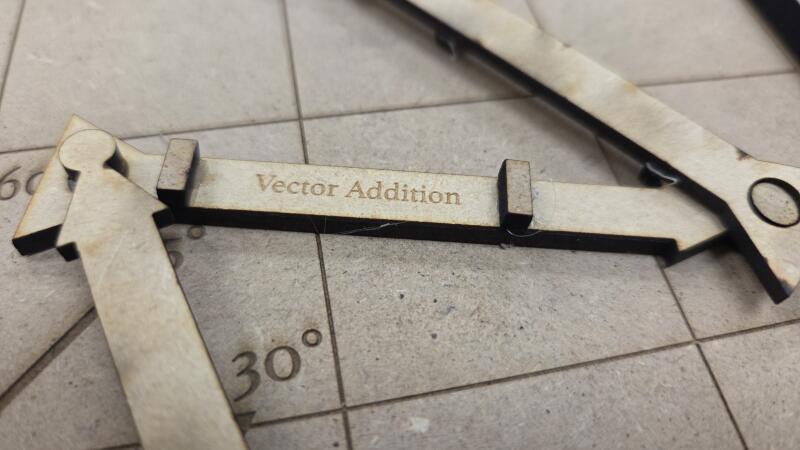
Vector Addition with Laser Cutting
Could you have done this activity without the teaching aid you have fabricated? How do you think digital fabrication improves the activity vs utilizing traditional methods? What is the extra value? While I could certainly have prepared for this activity with more traditional fabrication methods, digital fabrication through laser cutting provides several benefits over production by hand. One of the primary advantages is prototyping. This project required multiple prototyping stages to investigate the size and shape of the vectors, as well as looking at multiple methods of connecting the vector pieces together. Another major advantage is the speed of production and the ability to quickly assemble multiple kits with total accuracy to measurements. Additionally, laser engraving allows for the creation of a built-in grid and protractor on the base, which would otherwise have had to be carefully traced or printed on paper.
What are some challenges you expect when you do the activity with your class? Design-wise, one concern I have is the structural integrity of the central peg. Material availability led to me using lower-quality MDF for the 3.15mm prints which could break with use. Pedagogically, my primary concern is initial buy-in, as many Grade 11 students like to pretend that they enjoy playing with toys quite a lot less than they really do. Additionally, I am certain that there may be unforeseen issues with the overall design that may contribute to inaccuracies in measurement. The physical materials will be supplemented by digital and visual representation, so I hope to give students multiple ways of visualising their assigned problems.
What did you learn during the fabrication process? The primary lessons that I took from the fabrication process were learned in the early phases of initial ideation and design, and the later testing phases as well. By this point, I have a fair amount of experience doing vector design and using digital fabrication tools like the laser cutter, but I often struggle to find reasons to use them. Being forced to come up with an actionable lesson plan that uses digital fabrication made me take the time to not just sit down and think through what areas of my curriculum could use a constructed tool, but also to consult with Alec as a sounding board for those ideas and feedback. It was interesting to see the sounding board from the other side, as usually I am the one helping students to develop their own ideas in Design class or in our Grade 9 Science Fair. Additionally, after iterating through several versions of the vector connectors, I consulted fellow physics teachers and some of my students for feedback, which resulted in the final (well, current actually; there’s still plenty of updates I could make to improve the design) version.
Field Activity 2
Calculating Forces on an Inclined Plane
How well did the activity align with your intended curriculum or standards, and what adjustments (if any) would strengthen this alignment? Physics conforms well to idealised simulations. Simulation gives a great deal of control over values that is more difficult to achieve with physical props, particularly when it comes to inherent properties like the coefficient of friction. This assignment allows students to learn a bit of programming in order to create a tool that they can use to check their own work in many problems throughout the Dynamics unit, while allowing the instructor to assess their application of the logic of solving a problem of this type. I believe that these aspects make this activity very well-aligned with the learning objectives of this unit, and by extension, with the curriculum.
In what ways did students’ ZPD guide your decisions about pacing, scaffolding, or complexity of the activity? Due to this not being part of a programming course, I felt that it would be essential for the students’ ZPD to weight the activity’s complexity more on the logic of finding the net force and acceleration in the problem rather than in the code. While students can certainly use this assignment to create a detailed code addressing every possibility and able to extend to other inclined plane problems as well (and doing so would likely earn them extra credit), the primary focus is on their ability to translate a mathematical problem into a concrete set of solution steps, illustrated by the code.
What supports did you provide in the lesson plan to support diverse student needs? How did these supports work in the overall lesson? I could have included more detailed scaffolding/supports, but I have included a number of tips for aiding students in starting, including but not limited to presenting them with a simple problem and having them detail each step they had to take to solve it. Walking through these steps is essential for pattern recognition with these types of problems, and for the teacher to see where problem areas are in the logic. In areas of difficulty, in lieu of directly telling the student the following step, instructors can prod them with questions to encourage thinking towards the proper direction.
After testing the lesson, what changes would you make to better meet diverse learner needs or to better maintain the learning objectives? I have not yet had an opportunity to test this lesson, and will report back after having done so.

Field Activity 3
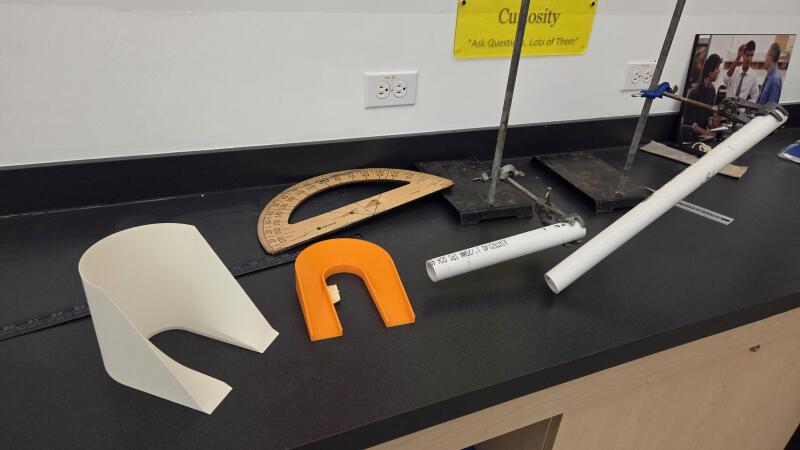
Centripetal Forces: 3D Modelling Banked Turns
Identify the source of the feedback: learners, colleagues, or AI. As I completed this lesson plan during March Break, I was not able to test with learners or colleagues. Instead I did a pilot test myself, and approached Gemini for feedback.
UPDATE — After March Break, I used this project as a Problem-Based Learning lesson, inverting the objective. Rather than having students construct the turns themselves, I gave them ones that I built and challenged them to use Free Body Diagrams and their understanding of combined forces to determine what speed would drive down the centre of the turn.
Describe how you collected the feedback: through observations, written feedback, direct questions, etc. Iteration was a large impact on my feedback process. I developed multiple versions of the design before arriving at one that was reasonable, effective, and functional. In addition, I posed direct probing questions to the LLM to double-check my thinking was within reason.
What was the specific feedback about how the project aligns with learning goals? How does the assessment align with the learning goals? Does the assessment protocol make sense within the lesson (ie. type of assessment, pacing, difficulty of implementing)
 Consulted an LLM audit of the lesson plan. The feedback highlighted that while the physical test is a strong summative assessment for the physics goals, the sustainability goal requires explicit documentation of material usage (e.g., slicer weight estimates) to be truly measurable. The feedback also suggested implementing a ‘Recovery Protocol’ for print failures to ensure that technical issues with the printer do not prevent students from completing their physics assessment.
What are some changes you made or will make based on the lesson testing and feedback? I think that putting more focus on effective slicing and collecting information from the slicer is an excellent suggestion for minor improvement, and the estimated print mass can be compared afterwards to the actual measured mass.
Did you succeed integrating developed sustainable goals / sustainability? Are they include in the learning goals and assessment? There were any challenges related to the integration? I implemented SDG 12, Responsible Consumption and Production. I did have some difficulty brainstorming activities for Physics 11 that directly integrate with the Sustainable Development Goals, but my two primary foci in integrating SDG12 were on material use in production and in reducing tire wear at high speeds. Reducing the amount that a racing automobile needs to turn allows for much longer lifetimes for tires and less rubber pellets wasted on the road. This SDG is implicitly included, but not explicitly.
Field Activity 4
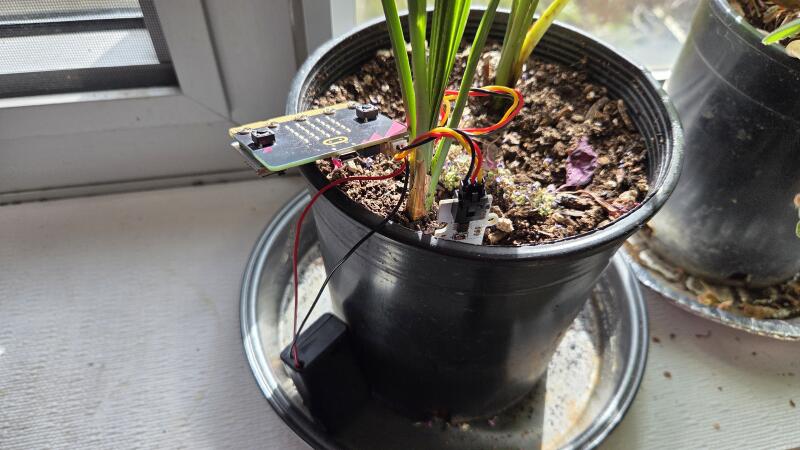
Plant Monitoring with micro:bit Sensors
Collaboration: Reflect on how you worked with colleagues or FLA participants during the Field Activity. At what stages of development and testing did the collaborator contribute? Please be detailed in your description. How did your collaborator’s perspective change the way you developed the lesson? In this Field Activity, I collaborated with colleagues and another FLA participant.
My original intention was to build a lesson around optics, as a collaboration between Physics, Design, and Environmental Systems Science. I discussed with an ESS teacher at LCC, and he contributed the idea for a lab experiment examining the relationship between ocean salinity and light refraction. I was going to use this as an opportunity for students to construct their own sensors for the lab, which would allow them to consider the thought that goes into the development of devices like light sensors. However, as the project increased in complexity and the IoT/microcontroller element became less and less central to the design, I pivoted to a new project.
At the same time, Noel returned to school from parental leave, and he came in with an idea for a project that was perfect for the work that I had done on my light sensor idea. With his experience in 3D design and mine in programming and electronics, we put together the Smart Plant Systems project.
Instructional Challenges: What challenges did you encounter while teaching this lesson? How did you address or plan to address them? How are diverse learners’ needs being met in the lesson plan facilitation? This lesson has not yet been implemented in the classroom. Challenges that I anticipate include:
- Student distraction is always a concern, particularly among students of this age group. It is difficult to keep students on-task even when there is a limited amount of time to complete an activity.
- Student overwhelm is also a potential challenge. While the lesson is designed specifically around giving students of varying levels of development a chance to contribute and succeed (low floor, high ceiling), it is not uncommon for students to feel intimidated by optional tasks like the ‘advanced micro:bit techniques’ and the depth of environmental data that is possible to gather.
- Available time is consistently an issue in this class, as there is usually only one class period in a week. A student missing a period (or worse, an event happening during the period or a big game taking multiple students) can mean writing off an entire week and needing to pick up the following.
Integrating Disciplines: Where does your lesson plan fall on the continuum and why? How might you move the lesson plan along the continuum to the next level? While this lesson has elements of transdisciplinary integration in the use of techniques from one discipline being used to solve a problem involving another, it is mostly interdisciplinary, with a larger focus on the design elements than the science elements. To move towards transdisciplinary, I would involve the science teachers at the grade level in question and include more of a focus on studying why particular plants have different needs. What is biologically different about a succulent like echevaria and a herb like Thai basil? This could lead into a larger discussion about biodiversity, while still retaining focus on the “problem” of the characteristic properties of the chosen plant.
AI Usage: If you used AI, describe how it was used and in which steps of the Field Activity. The only stage at which I used any LLM input was as a critical review after the completion of the lesson plan. No GPTs were involved in the development of the procedure or technical elements of this lesson.
Reflect on the course in general: How has your teaching changed as a result of this course? What are some concepts that you would like to learn more about? How can you support other teachers in your practice to use digital fabrication with their students? Throughout this course, I have continually challenged my ideas of how design technology and digital fabrication can be used in classes besides simply design- and art-related courses. I still need to work on my implementation of Design by Students in the classroom and trusting that these types of activities and lessons can be used alongside traditional methods of teaching, but I think that I have grown a great deal in my consideration of Design for Students. Next year, I will try to find time to attempt some of the lessons that I designed this year in the classroom to encourage students to physically build solutions to Physics problems. I still have much to learn about specific DF methods, but I feel much more confident about going into the LCC Fab Lab and trying just about anything.
I think the first step in supporting other teachers is modelling. If I can show other teachers in my department that it is not just possible, but rewarding to implement DF into the classroom, then I can begin encouraging them to try themselves. Additionally, Noel and I both intend to give a presentation at a future staff meeting about this course to encourage others at LCC to sign up to be FLA certified, by sharing our experiences and how we have grown as designers and teachers through participation in the Fab Learning Academy.