Week 8: Biomaterials
Assignments
This week you would need to create a mold to produce a biomaterial. You have two steps:
Create the mold: * Option 1 [HIGHLY RECOMMENDED]: Create the mold in wood/acrylic using the laser cutter. Instructions for creating molds. We also provide a few strategies after manufacturing. * Option 2 [ADVANCED]: Create the mold using a 3D printer (mainly for a 3D object) Together with your local instructor and colleagues cook your own material and pour it into your molds. We provide different possible recipes. In addition you should answer the following reflection questions:
- Have you considered sustainable practices in your teaching in the pasts? How? What aspects do you think should be improved in your own teaching environment?
- How Digital Fabrication might support sustainable practices? When using Digital Fabrication what actions you can take to support sustainable practices.
- How could you integrate both culturally reflective learning and digital fabrication in your environment? Could you come up with some project ideas using digital fabrication in which cultural diversity of students is highlighted?
Process
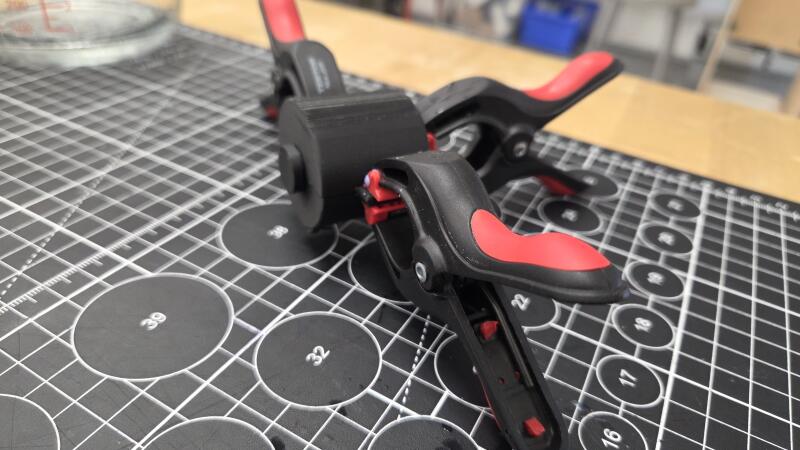
Though I created a mold in last week’s project, I have not had an opportunity to test it with any biomaterials yet, as the materials are not presently available for agar, resin, or alginate moulding. I could use gelatin, but I do not use animal products. What is the point of aiming for sustainable production if we are just going to kill animals to do it? I was intending to use a sodium alginate solution, though some of the tools were unavailable in the lab. I will approach again with another attempt at a later date.
Update
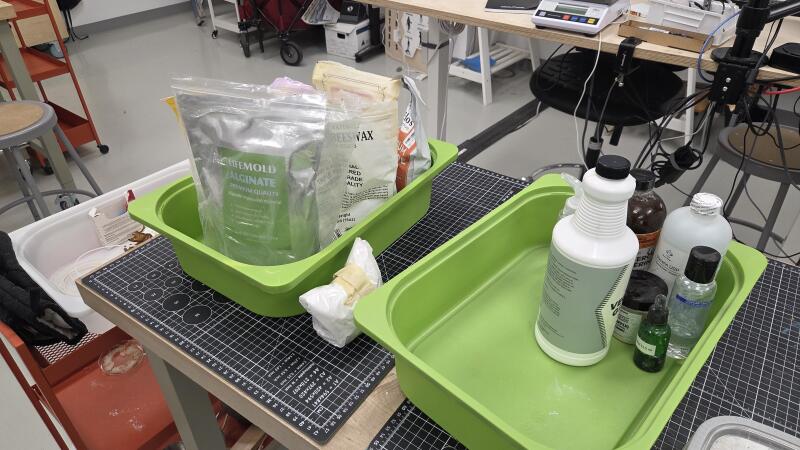
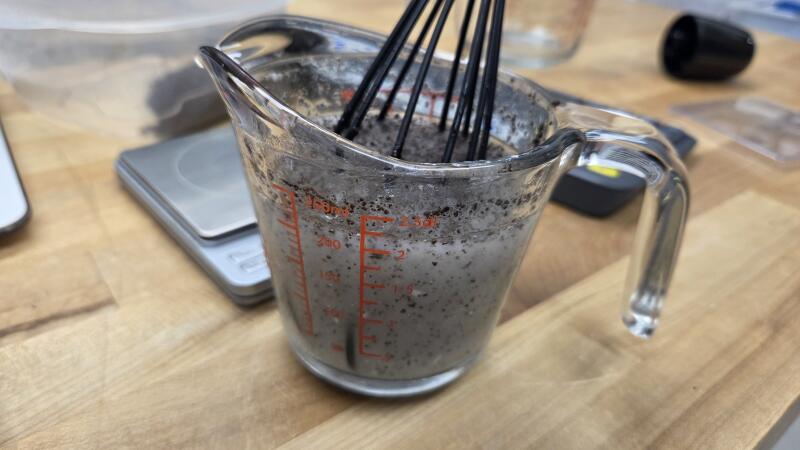
I attempted to use an alginate solution for my casting, using SheMakes’s recipe as a base. I procured the alginate, water, glycerol, CaCl2 solution, coffee ground filler, and the necessary equipment from the Fab Lab, and quickly learned that our stick blender was not functional. As a result, I whisked the ingredients together by hand to make the solution. After I was sure that it had been completely mixed, I put the solution aside to set.
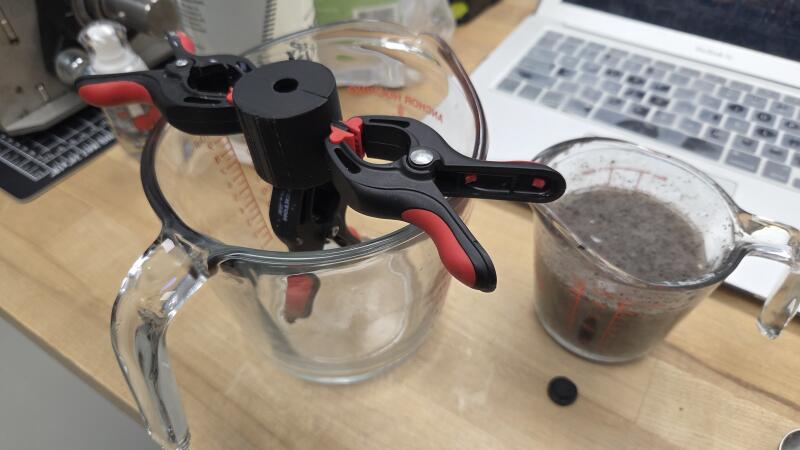
I sprayed down the mould with CaCl2 solution, and assembled it over a large measuring cup, in case of small amounts of spillage of liquid, then I poured in the solution, wiping away any excess with a paper towel, and leaving it to dry in the casting mould.
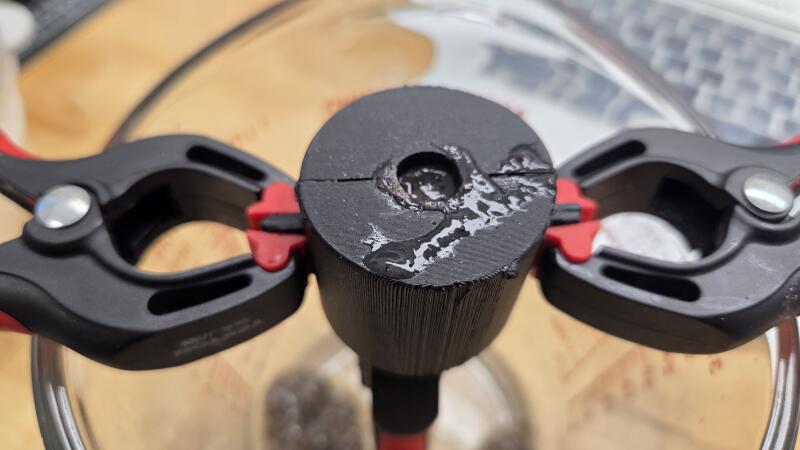
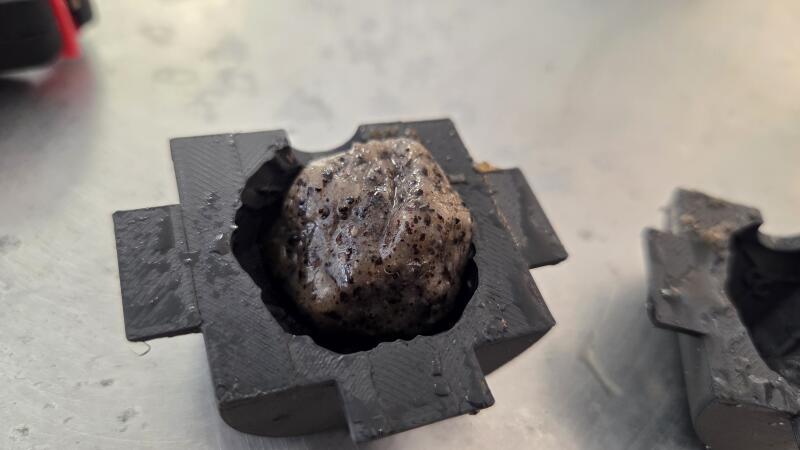
After waiting for the solution to dry, I returned to the scene of the crime to find, unsurprisingly, that my first attempt at biomaterials production had not succeeded as intended. On drying, the material lost most of its volume, which resulted in a very small, sad lump within the mould. Nevertheless, despite the failure, I am encouraged to attempt more biomaterials production in the future to learn how to successfully accomplish my goal.
Reflection
- I could certainly be considering sustainable practices on a larger scale, but I do think that I have put some amount of thought into them in my classroom, particularly when teaching design. A big focus in our FabLab has always been on responsible use of material and diminishing waste, considering the ‘four Rs,’ Reduce, Reuse, Repurpose, and Recycle — reducing use of materials to what is strictly necessary, designing for reuse of excess materials, and when necessary, recycling waste products into new material. In Middle School, we try to teach students effective cutting methods to maximise leftover material, and we often design projects with the intention of getting students to consider sustainability, both in their material use and in the scope of their ideas.
- One of the primary benefits of DF is precision. If the product is well-dimensioned in CAD software, the DF device will, barring errors, produce it without mistakes. This reduces waste from random operator error while maintaining a high speed of production. As well, though some DF devices generate waste (for example, misprints and structural supports from 3D printers), in many cases that waste can be either reused or recycled. In our LCC FabLab, there have been projects to come up with productive and unique ways to reuse filament scraps to create new building material.
- A key element of cultural reflection is allowing students to be their own voice for their cultural experience, and listening to their needs. Oftentimes this may mean confronting one’s own biases, but a teacher who does not listen to and attempt to understand their students is not a teacher that is fully doing their job. Design, whether it uses DF or not, is an avenue for students to allow their cultural experience to speak for itself. Giving students freedom to find their own voices through project design can be very liberating. All that said, I’m not really in a place where this is possible at the moment. Physics is a topic that, while not devoid of culture, is mired in the objectivity of mathematics and understanding the logic, and does not leave much time for interpretive projects. Grade 9 Science gives some more opportunity in the Science Fair project though, as this project gives them the freedom to scienctifically investigate any topic they find important or interesting. However, often students are so preoccupied with the difficulties of designing an experiment for the first time that they do not have the headspace to consider use of digital fabrication in their designs!
Tools
- Bambu Lab P2S 3D Printer
- Sodium alginate powder
- Glycerol
- Whisk