Week 5
Assignments
- [ ] Task 1: Create modular simple parts which press-fit together
- [ ] Task 2: Assemble something out of them.
Process
- I used the makeblock structural parts as template, then modified them such that I could interlock some of them, and created a rivet style fastener to join them together without any metal hardware at all.
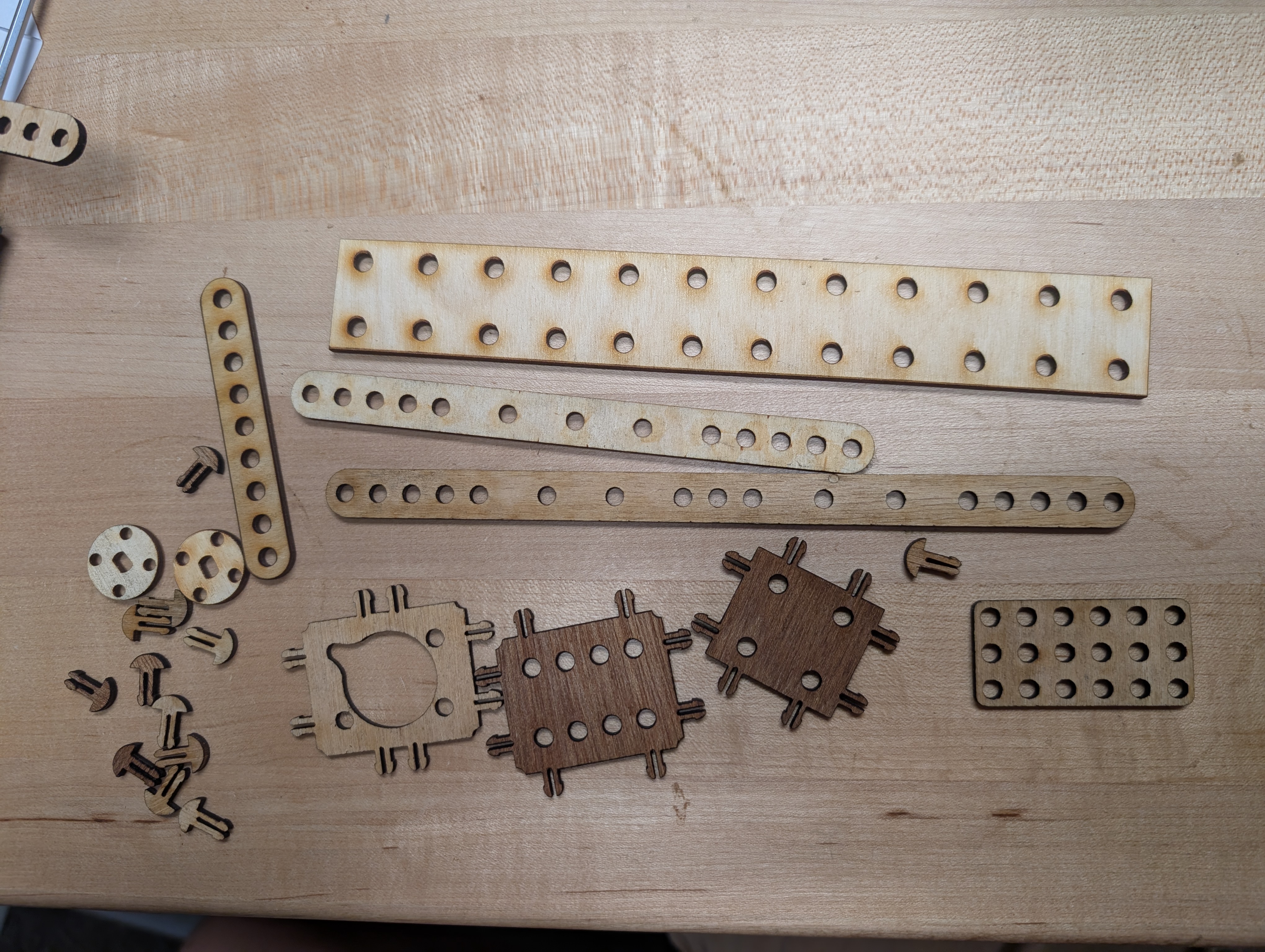
- I quickly discovered that the cardboard was not sturdy enough to be used this way, wood was minimally necessary, and even then, sometimes parts broke when tolerances were too tight.
- I started to create an arm with a flexible joint, and of course ran into limitations with the parts I had made…
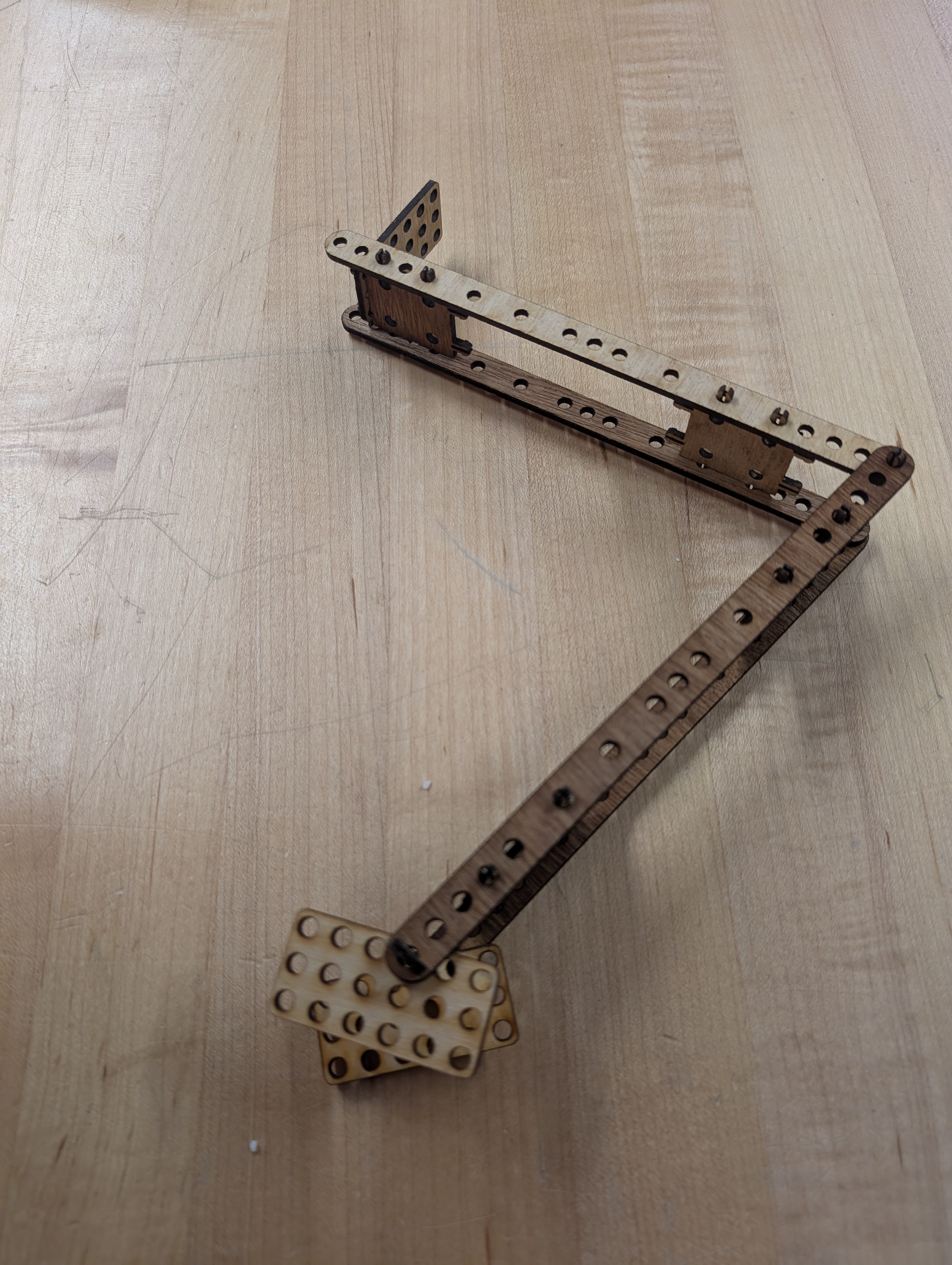
- I wanted to create more parts to finish the arm, and realized I was exceeding the scope of this activity.
Reflection
This kit was an attempt to solve some of the most challenging aspects of kits like makeblock. These kits often rely on large volumes of expensive or proprietary metal hardware which, once invested in, belongs to the school. The children interact passingly, creating models which have to be stripped down and reset for others to interact. Modifying pieces is a destructive act, far from recommendable.
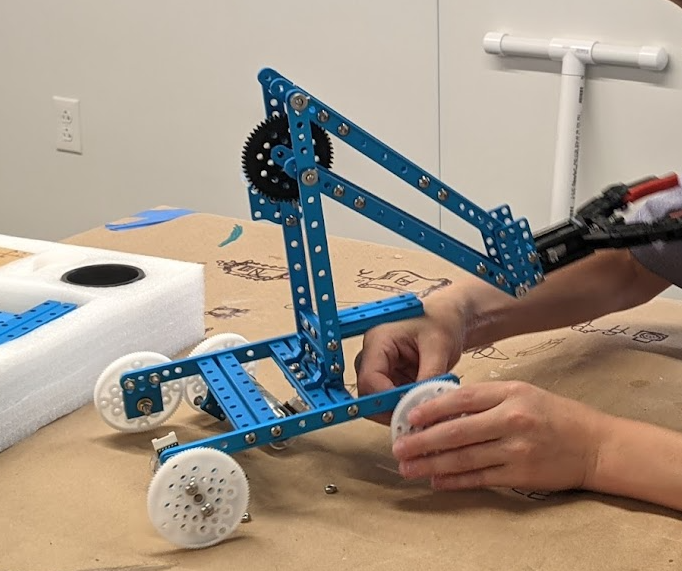
In Robotics, students are often tasked with prototyping quick assemblies, and occasionally struggle with finding the all the hardware and parts necessary. With quick wooden parts which can mimick those forms, students can prototype design choices rapidly, without limitations on how fast fresh metal parts can be aquired. Teaching students to create their own kits of such parts also gives a structured pathway that starts with replicating existent features, and migrates to creating custom parts. When parts can be made of simpler material, and easy enough to remake, students gain capacity to take home thier concept, to work on without worry of loss, or simply at the end of a full course. This reduces some of the reset, and cycles older parts out before failure. After maximal use, parts and assemblies made of this wood can biodegrade more sustainably.
I do see the utility in this concept though, in delivering kits of parts which allow students to build quickly and customize as need warrants, then … in a way that the expense of metal parts does not allow, every student can take their completed project with them at the end of the lesson series. I find this is important for projects which pass a certain threshold of perceived accomplishment– if a child feels they have done something considerable, they tend to want to show it off to grandparents and the like. This is easy enough with a cardboard diorama, but why not a robot? I have a colleague who uses a similar philosophy with hand-cut paper parts in a project where students develop a marble-rollercoaster as part of a science course. I am curious about collaborating with her toward some bespoke and modular kits of cardboard or wooden parts. it is important for children to learn how to build. Building translates to
I have never built an educational portfolio, though its utility is not lost on me. I have tried to keep a record of educational projects I have attempted successfully or otherwise, just as a running log of my own experience, and believe that organizing such into an education portfolio would be a great way to share the success of that experience with others on similar paths.
When I execute a learning activity, the success evaluation is based primarily on the degree to which students seem to leave the classroom with a sense of having accomplished something worthwhile. On the short term basis, I keep a running tally of how many students ask when the class period will be over, and over the course of longer projects, I try to estimate how many students reflect on having talked to anyone outside the class about what they have accomplished. Modifications and improvements are logged in version numbers for lesson assets, but having a relatively fuzzy metric of success means it can be difficult to tell how much improvement was had until a reasonable number of iterations have been had without changes– and something always seems to be changing. Having not kept much in the way of a diary or portfolio does also mean that annotations and reflections on noteworthy changes are not as easy to find as they could be. The practice of these notes seems a worthy way to address that.
Tools
- Onshape and Illustrator for CAD/CAM
- Epilog Helix for cutting.