Week 1. Student-Centered Learning Approaches. Electronics.
This week I’ve been learning the basics of electronics and creating simple circuits using TinkerCad. The following photos show a simple circuit consisting of a 3V battery, an LED bulb, a resistor, and a switch. When connected correctly, we see that when the switch is off, the bulb doesn’t light. Conversely, when the switch is on, the bulb lights correctly.

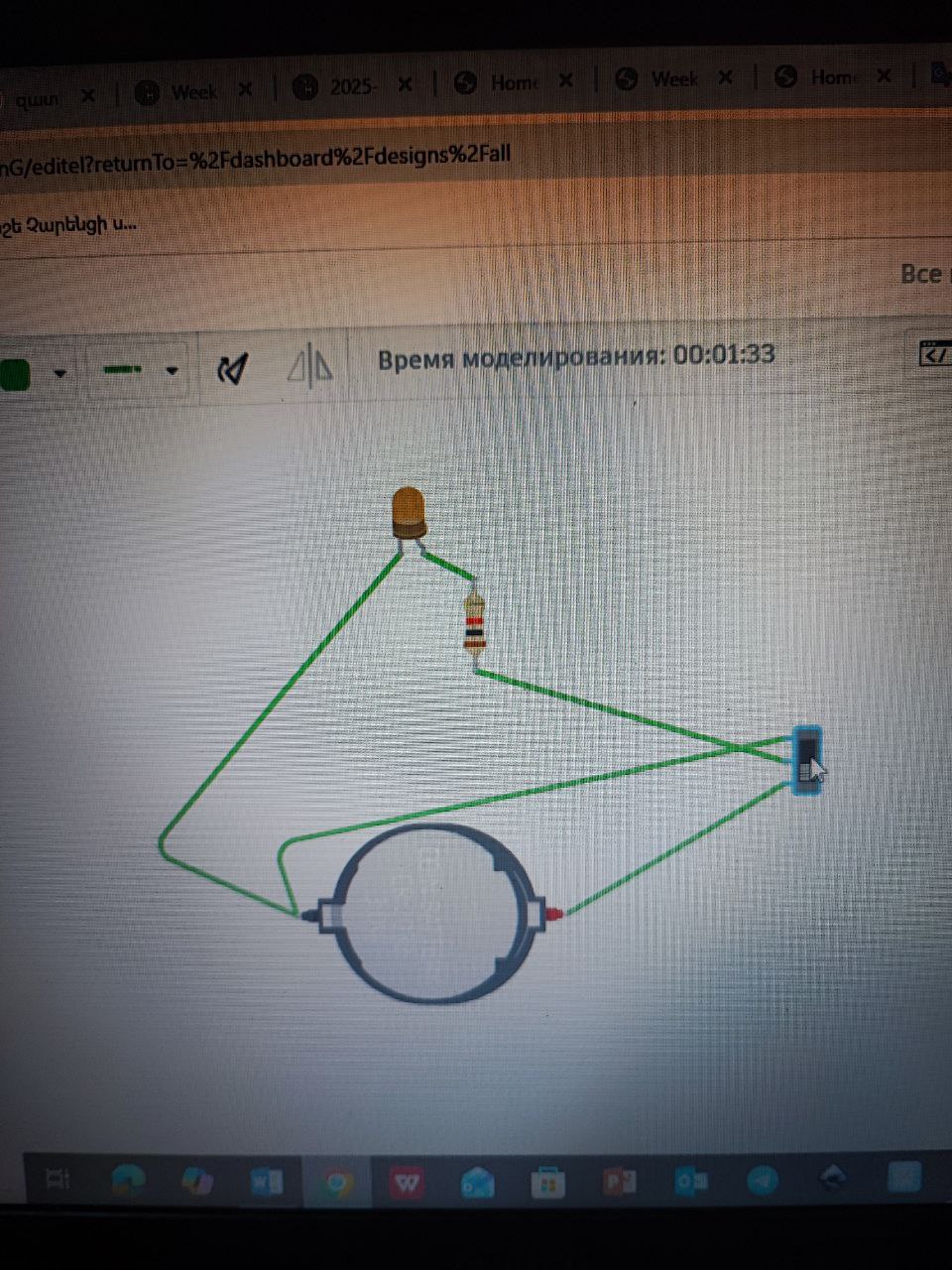
The main challenge was to correctly connect the circuit elements. It was important not to confuse the positive and negative poles. While working, I had some trouble fixing the wires. To solve this problem, I used a soldering iron.
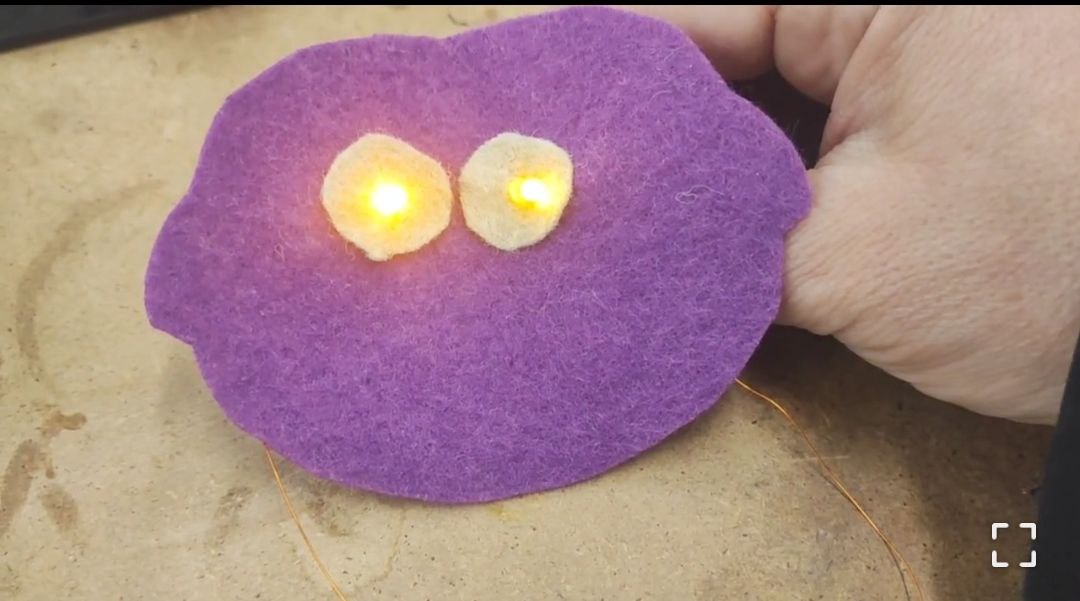
As my second circuit-building project, I created a prototype of a human face using LED bulbs, a resistor, a battery, and wires. Felt was my main material.
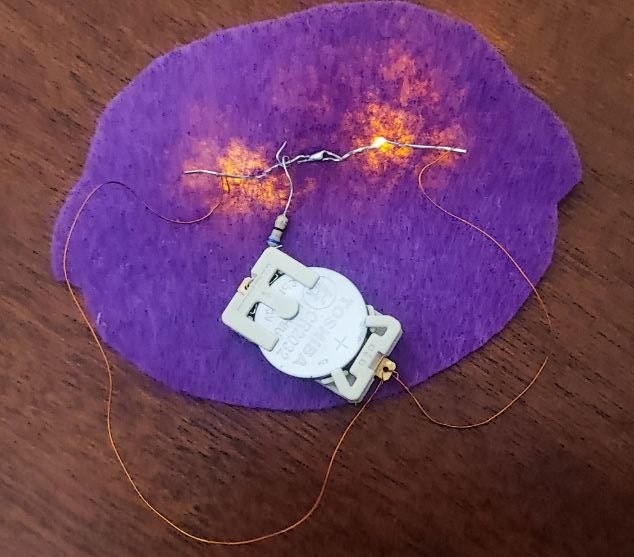
This is another side of face, where we can see circuit.
1.Imagine an educational activity using simple electronics components (preferably without microcontrollers) that is suitable for the age group that you are teaching. Describe it (provide goals of activity and methodologies). Consider also the role of the kids: would you classify it as Digital Fabrication for kids or with kids? Why? It is preferable that you integrate any of the circuits you have created in step 1 or 2.
A lesson using electrical circuits for a group of students aged 10-13 might look like this: we study the properties of circuits together and try to solve specific problems using these properties. This can be a learning format for children or a format for learning with children. An example would be creating electrical New Year’s cards for a Christmas bazaar. Another good example would be creating fairy tale or storytelling characters where we could use LED bulbs instead of eyes. For example, the characters in the fairy tale “The Turnip” could be created as parts of a single circuit, and only at the end of the story would the circuit be completed and all the characters’ eyes would light up when connected. The circuit I created in step 1 will be integrated here. I would classify this lesson as a DF lesson for children because the circuits are quite simple, and children their age could easily create them, as well as think up and draw simple characters. Of course, they would need the teacher’s help at some stages. The methodology should follow a STEAM-based inquiry model. Earning objectives of this lesson may be: 1. Identify the necessary components (power source, conductor, and load) required to create a closed loop. 2. Distinguish between the positive (+) and negative (-) terminals of LEDs and coin cell batteries to ensure current flow. 3. Differentiate between conductive materials (conductive thread, copper tape) and insulators (felt, hot glue, regular thread). 4. Understand Circuit Continuity: Identify the necessary components (power source, conductor, and load) required to create a closed loop. 5. Students must learn to articulate their story while simultaneously manipulating the circuit.
2.What are the challenges of using electronics in your space? How can this support your students in learning classroom content?
The main problems and challenges associated with electronics are that they can’t actually see the flow of electrons. They need to be explained using associative examples, such as the flow of water. There may also be issues with proper wiring and safety precautions. e from one to another. For example, I’d like to highlight the safety issue of soldering iron use for this age group. For the younger group, there may also be a danger of swallowing a 3V battery.
3.What has been your experience using Project Based Learning / Problem based learning in the past? What were the main challenges?
I have experience using project-based learning/problem-based learning in the past. Since I don’t teach it in my classes, it’s primarily used to address social and community issues in the classroom, school, and city. The students were tasked with congratulating teachers and mothers on Mother’s Day. Using Fab Lab technology, specifically laser cutting, we cut out plywood brooches and gave them as gifts. This could also be considered an excellent example of social learning.
The main challenges I encountered with project-based learning were the proper assignment of roles during project implementation and the implementation process from the initial idea to the actual project.And I think the most challenging part is ensuring students are equally engaged in the process, regardless of their abilities and backgrounds.
Tools
- TinkerCad platform
- Felt, battery, LED lamps, resistor, wires.
- Soldering iron