Week 3. Teaching for all. Programming.
This week I created a small scratch game.
The main character is a bear who wanders through the forest collecting all sorts of things.
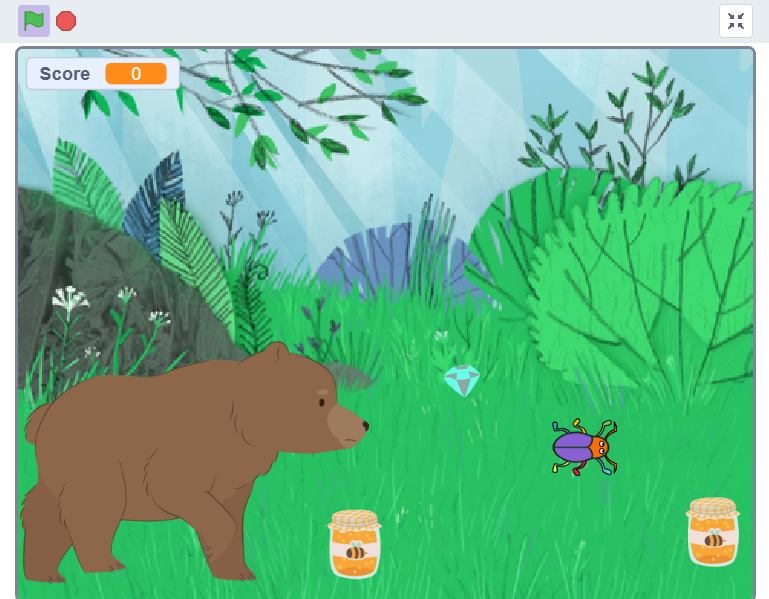
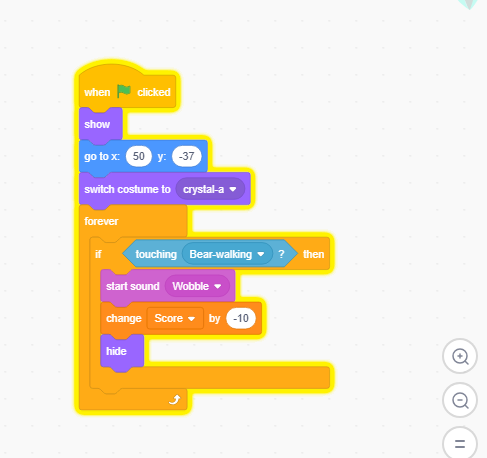
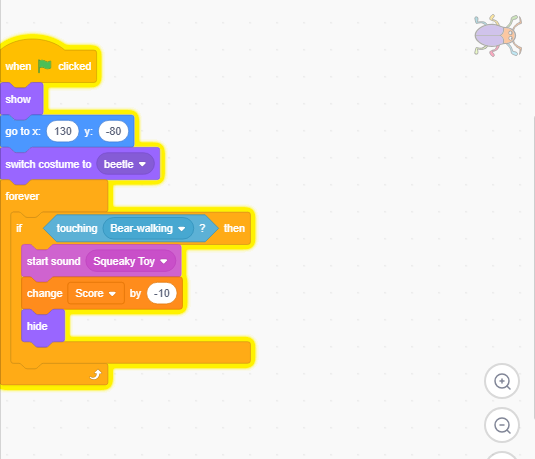
Some of the items are uneatable for the bear: when they do, he makes a sound and points are subtracted from his total score.

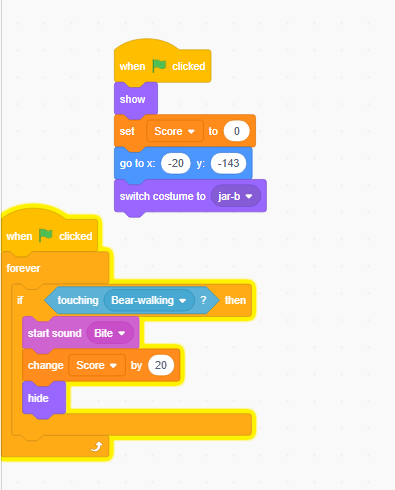
When he finds honey, points are added and he makes a chomping sound.
I also used the bear’s movement feature using the costume function.
This is the link of my Scratch game.
I think, programming can be used in classes. Firstly, it greatly develops algorithmic and logical thinking. Secondly, it helps students retain the knowledge gained during lessons. For example, students could create scratch games to help them reinforce the material covered in specific subjects. This could be a simple biology scratch game called “Cell Components” where the main characters are cell parts; when clicked, they explain themselves and their functions.That’s about the possibilities. As for the challenges, programming as a skill can be challenging for some students who struggle with it. Therefore, I would probably only use programming in lessons with a group of students who are predisposed to this skill. The remaining students could use a program created by their classmates.
1. When you design a DF learning activity, how do you take into account diversity? Could you describe one learning situation in which you did not take into account diversity in planning? How did you solve the situation?
My class includes students with both inclusion and special needs. During a lesson where we were making New Year’s cards for school Christmas Bazaar, they struggled with building electrical circuits. But they were very eager to participate. I solved the problem by giving them a simpler task: coloring a card, after which their classmates helped build the circuit.
-
2. What aspects would you need to take into consideration if you have kids
-
a. learning disabilities
-
b. physical disabilities
-
c. emotional disabilities
when preparing your DF activities?
a. For children with learning disabilities, simple step-by-step instructions should be developed instead of lengthy directions. Their tasks should be simpler than those for everyone else. For example, if all the other students are working on developing a laser cutting file, they might be coloring a finished product or separating it from the cutting process. The key is to explain things clearly and to the point. b. For children with physical disabilities, it is necessary to create a comfortable, understandable workspace. When explaining material, speak loudly or use gestures. If they have vision problems, it is necessary to explain in advance where the danger zones in the lab are, or a warning signal should be heard in these areas. Instrument shelves should be located at an accessible level for a person in a wheelchair. c. For children with emotional disabilities, it’s important to work on their thinking. Since the digital lab is a place where experience is gained through trial and error, these students need to be taught to react calmly to mistakes. When programming, errors should be addressed in a playful manner. For example, instead of pointing out errors in the code, call the correction process a “bug hunt.” Since the digital lab is a noisy place, these students should be warned about this in advance, as they are very sensitive to noise.
3.Do you think your school is ready to a change in mindset? Why? How can you get support from other stakeholders?
I believe all of the above aspects need to be taken into account, and in this case, an individual approach to each student with inclusion is necessary. Our school is ready for this because, as a non-governmental organization, it has the ability to change and implement curricula. Our city also has a public organization that works closely with schools and helps with teacher retraining and curriculum development. There are many integration challenges, from the integration of the student with inclusion to the adaptation of curricula. As an opportunity, I would note a change in the attitudes of other students, mutual support, and tolerance for each other.