Week2. IoT. Administration of IoT in schools.
This week I managed to connect the next microcontroller to my phone.
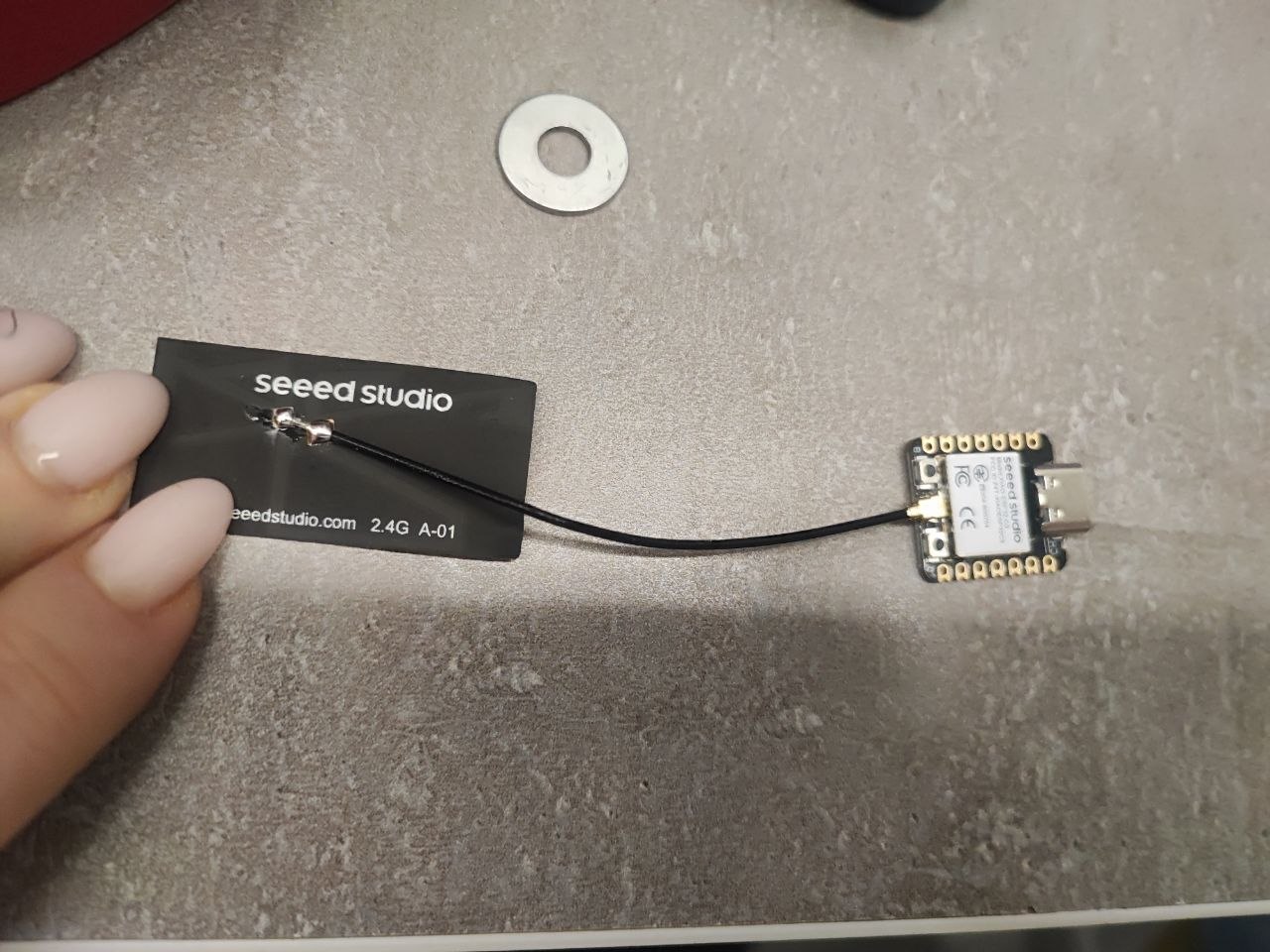
This required downloading the Blynk IoT app to my phone. After that i followed the instructions to pair the esp32 and phone
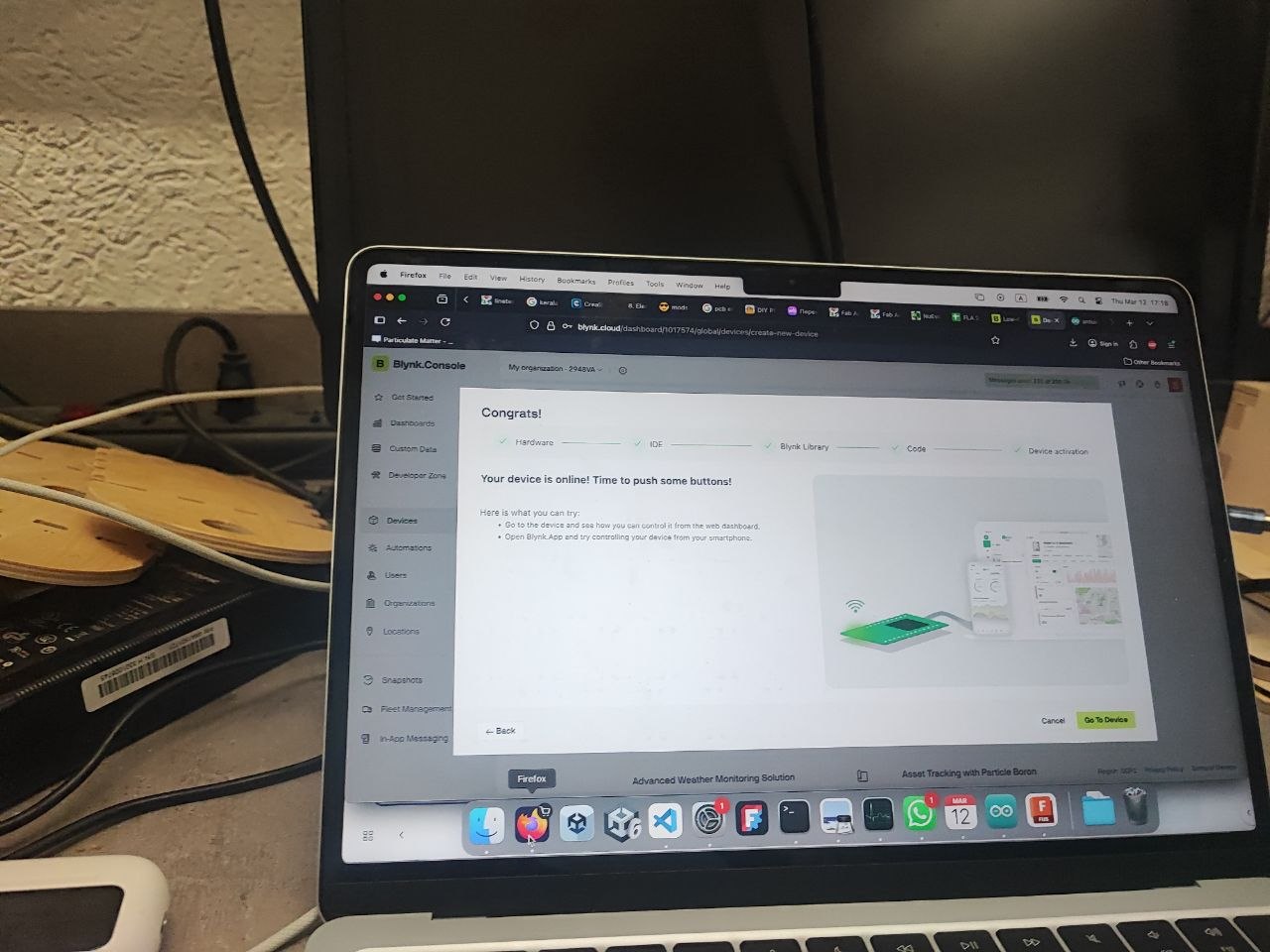
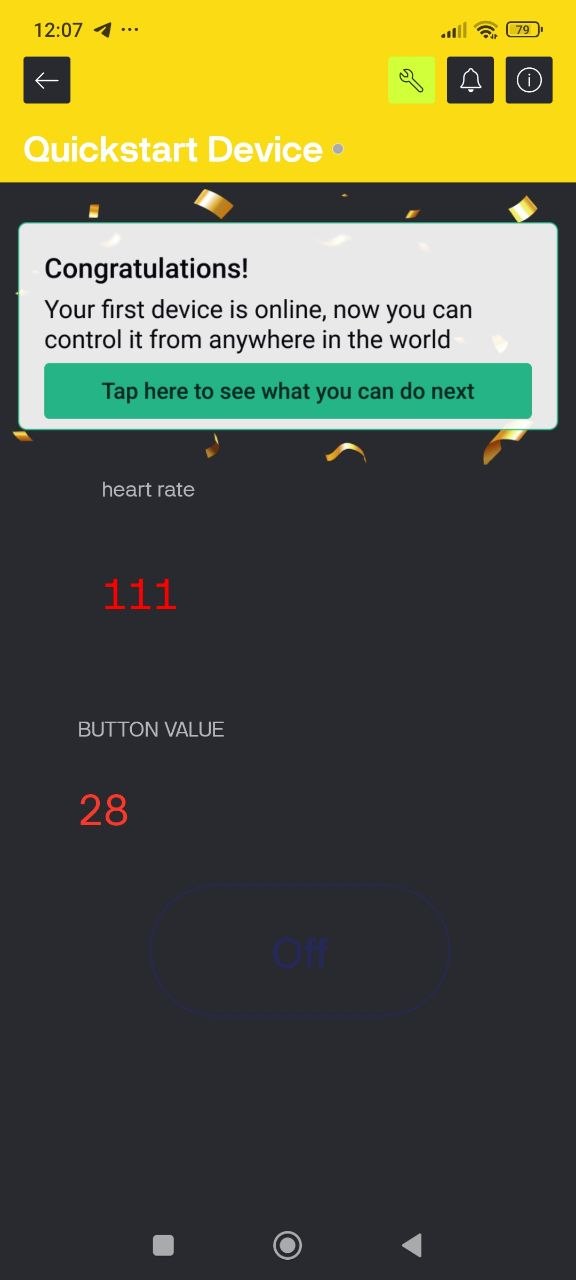
Finnaly, i uploaded a program on the esp32 to transmit heartbeat sensor data to the phone.
In the next step, I programmed the following two microcontrollers and performed two operations:
-
Transmitting a message from one to the other and
-
Turning on/off an LED lightr remotely.
To perform these tasks, I first needed to implement the following processes:
-
Determining the recipient’s MAC address
-
Initializing ESP-NOW
After this, the connection is established and it becomes possible to send a message. This is what the program for sending messages to the sender and recipient looks like:
** to find the MAC address:
- Define the receiver MAC Address
uint8_t broadcastAddress[] = {0xFF, 0xFF, 0xFF, 0xFF, 0xFF, 0xFF};
- Initialize ESP-NOW
if (esp_now_init() != ESP_OK) {
Serial.println(“Error initializing ESP-NOW”);
return;
} 3. Send message
esp_err_t result = esp_now_send(broadcastAddress, (uint8_t *) &myData, sizeof(myData));
For sending message I used 2 programs:
for sender & for receiver.
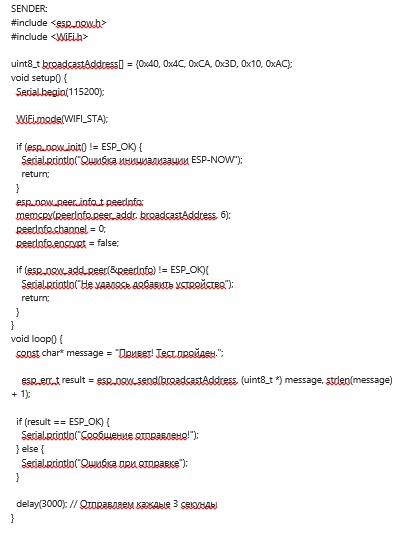
For receiver
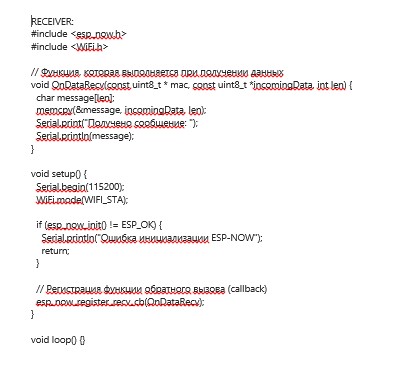
This is the result:
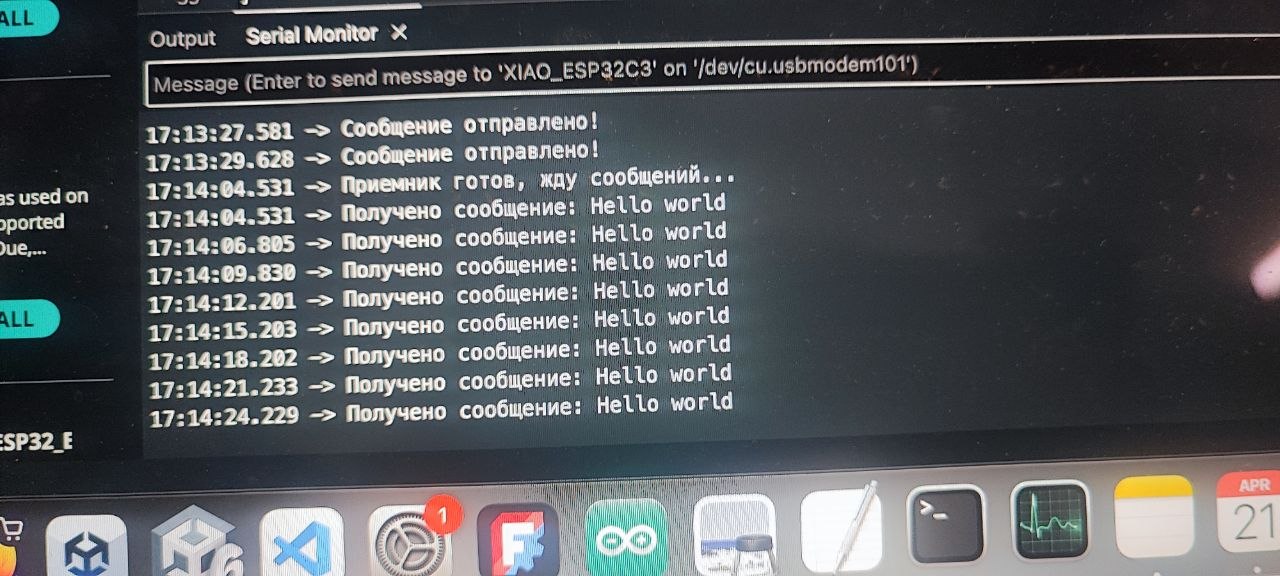
At the last stage, I tried to write a program to transmit the LED lamp on/off command over a distance: from one controller to another.
Sender’s program code:
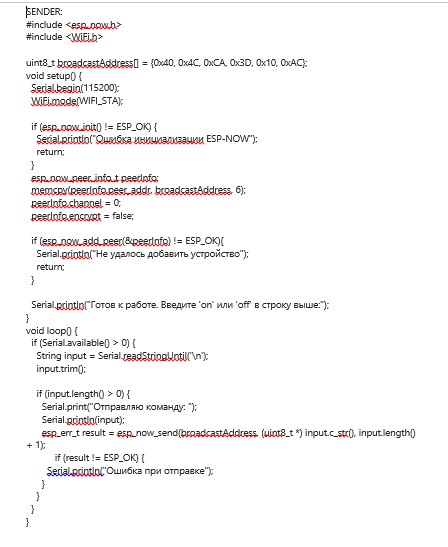
Receiver’s program code:
Result
Reflection
1. What are some opportunities in your context to work within your local community? Who you could collaborate with? How? What should happen to succeed in the collaboration
Our region, despite its small size, has many opportunities for collaboration. In Dilijan, there’s the Tumo technology cluster for teenagers aged 14-18. I think we could collaborate with them, but our workshop would need to be better equipped—as I mentioned, it would need a laser cutter, a vinyl cutter, a 3D printer, and other modern technologies.
There’s also a college and an international school in our region, but for now, our collaboration with them is limited to meetings at large events and the participation of our students in FabLab workshops organized by college students. We could collaborate on joint projects, but that’s for the future.
Another opportunity for collaboration is a community center where teenagers can go after school and volunteer.In any case, collaboration should occur based on interesting joint projects and mutual agreement.
2. What are the next steps in development further a makerspace in your school? How do you envision the maker space?
Our makerspace is well equipped. I mentioned earlier the technical devices I’d like to add. I’d also add experimental zones and clusters for working with groups of students, but that would probably require a larger space. I’d like to see a slight change in methodology. I’d really like for us, who have gained knowledge in the field of DF, to be able to share our experiences. For example, holding master classes led by experienced instructors. Perhaps they could be more thematic. I’d really like to organize community events and City Day events there, for example. For example, on Good Deeds Day, we could make devices for collecting trash on the streets.
3. What is the potential of physical computing and IoT for your teaching? Do you have any ideas on how you are planning to integrate those techniques in your context?
Regarding the IoT, I’m not sure I’ll use it in my teaching, primarily due to the high cost of microcontrollers and their limited availability in our region and school.
Regarding physical programming, I can definitely say I’ll use it to create projects that support the idea of social learning. For example, I might try to create a drying alert system for houseplants at our school with my students.