Field Activity 4 Plant Saver
This week I completed the Plant Saver project. It’s an interdisciplinary project that combines knowledge from physics, physical programming, biology, and some elements of social learning. The project was created in collaboration with fellow FabLab learning participant Suzanne Martirosyan.
Learning objectives:
-
Identify Plant Transpiration Requirements: Understand how environmental factors (light, heat, humidity) affect a plant’s water loss through its leaves.
-
Analyze Soil-Water Relationships: Explain how different soil types (sand vs. clay) retain moisture and how that affects sensor readings.
-
Determine Species-Specific Thresholds: Research and define the specific “wilting point” for a chosen plant species to set accurate irrigation triggers
-
Understand the role of a microcontroller (Arduino) in an electronic system.
-
Learn how to complete a simple circuit using an LED and a resistor.
-
Explain the Input-Output Model: Demonstrate how an analog signal from the soil is translated into a digital signal to light up specific LEDs.
-
Program a capacitive soil sensor to trigger visual alerts based on environmental data.
After that I tested the electronic part of the lesson by myself.
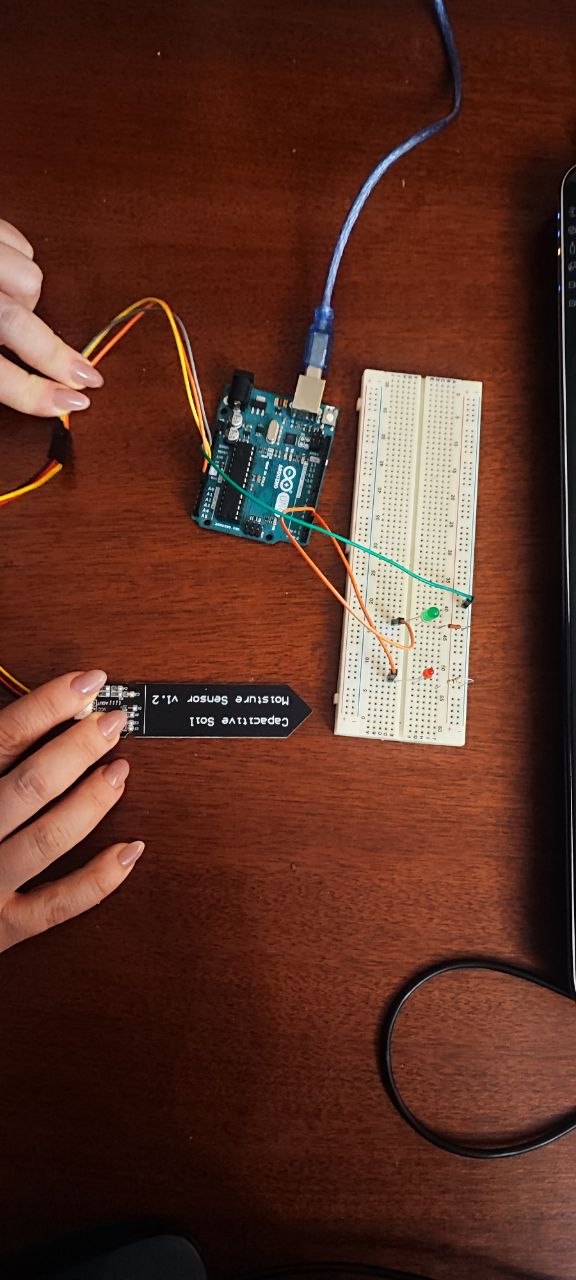
The idea behind Plant Saver was to signal that a houseplant’s soil was dry and needed watering.
The result can be seen on the video
This is the assesment protocolfor this lesson and these learning objectives.
Reflection questions
1. Collaboration: Reflect on how you worked with colleagues or FLA participants during the Field Activity. At what stages of development and testing did the collaborator contribute? Please be detailed in your description. How did your collaborator’s perspective change the way you developed the lesson? During this activity, I collaborated with my colleague, Susanna Martirosyan. My colleague works as a lab technician and is well-versed in the physics and biology curriculum, and she understands the skills and background of our students. Having completed Fab Lab learning last year, she has a good understanding of the basics of physics programming and Arduino.
Therefore, I even consulted with her when choosing a project. Initially, I had two projects in mind, but after discussing them with her, we chose Plant Saver for several reasons: 1. This project would be more appropriate for our students’ age and background. 2. The school implements a large project called “Forest” every year. We decided that this lesson could be used as a useful learning resource for research. After the lesson, we also discussed the project’s strengths and weaknesses, as well as possible ways to continue and improve it. As a lab technician, Susanna participated in research on the biological and geological components, as well as in debugging the Plant Saver software code. I think, that our collaboration was effective.
2. Instructional Challenges: What challenges did you encounter while teaching this lesson? How did you address or plan to address them? How are diverse learners’ needs being met in the lesson plan facilitation?
During the lesson, I encountered a situation where the students had varying levels of knowledge not only about physical programming but also about electricity in general. I had to explain some concepts and terminology from the beginning. But in the future, I might approach this problem differently: I’ll ask students with basic knowledge to help those who are struggling. When developing the lesson plan, I took into account that I might have students with different abilities, so the lesson is structured from simple to complex: first, a discussion, then a simple task, then the implementation of the project itself, and finally, open-ended questions for the most advanced students.
3. Integrating Disciplines: Where does your lesson plan fall on the continuum and why? How might you move the lesson plan along the continuum to the next level? Multidisciplinary Interdisciplinary Transdisciplinary
This is an interdisciplinary plan: the boundaries between subjects blur to solve a specific problem. I am not just teaching “coding”; I am using coding as a tool to understand botany and electronics. Biology: Understanding plant transpiration and the specific water needs of different species.
Computer Science: Using logic gates (if/else) and data processing.
Physics/Electronics: Understanding electrical resistance, capacitance, and circuit continuity.
To transform my Plant Saver lesson plan from interdisciplinary to transdisciplinary, I think, i need to shift the focus from the object (Arduino) to the global concept (sustainability or resource management).May be i can start the lesson not with the Arduino, but with a problem. Show a photo of a desolate local park and ask, “How can we know what a plant needs if it can’t talk?”
This activity fits into the Science 6, Physics 9, and Physics 10 curriculum. The curriculum includes a section on simple electrical circuits, and I think a teacher for these subjects could use this lesson.
-
Armenian Physics 9 and Physics 10
-
Armenian Biology 7
-
Armenian Sciesce 6 standarts & curriculum
4. AI Usage: If you used AI, describe how it was used and in which steps of the Field Activity.
I asked AI to change my assesment protocol by adding changed learning objectives.
5. Reflect on the course in general: How has your teaching changed as a result of this course? What are some concepts that you would like to learn more about? How can you support other teachers in your practice to use digital fabrication with their students?
My approach to teaching has changed significantly as a result of taking this course. Using digital technologies in teaching, creating projects, or solving problems greatly helps deepen knowledge.
I would really like to deepen my knowledge of the ZPD to better address the problem of engaging students with different abilities and knowledge levels. I think this is an age-old challenge that all teachers face.
I am also very interested in and passionate about project-based learning and problem-solving. Because as teachers, we often hear from students: “Why am I learning this?” And when they understand that the knowledge is applicable to real life and solving real problems, they learn the material better.
But most important to me is the topic of social learning. I believe that it is not enough to raise a person with a good level of knowledge. It is necessary that he be able to apply this knowledge for the benefit of the society around him.